
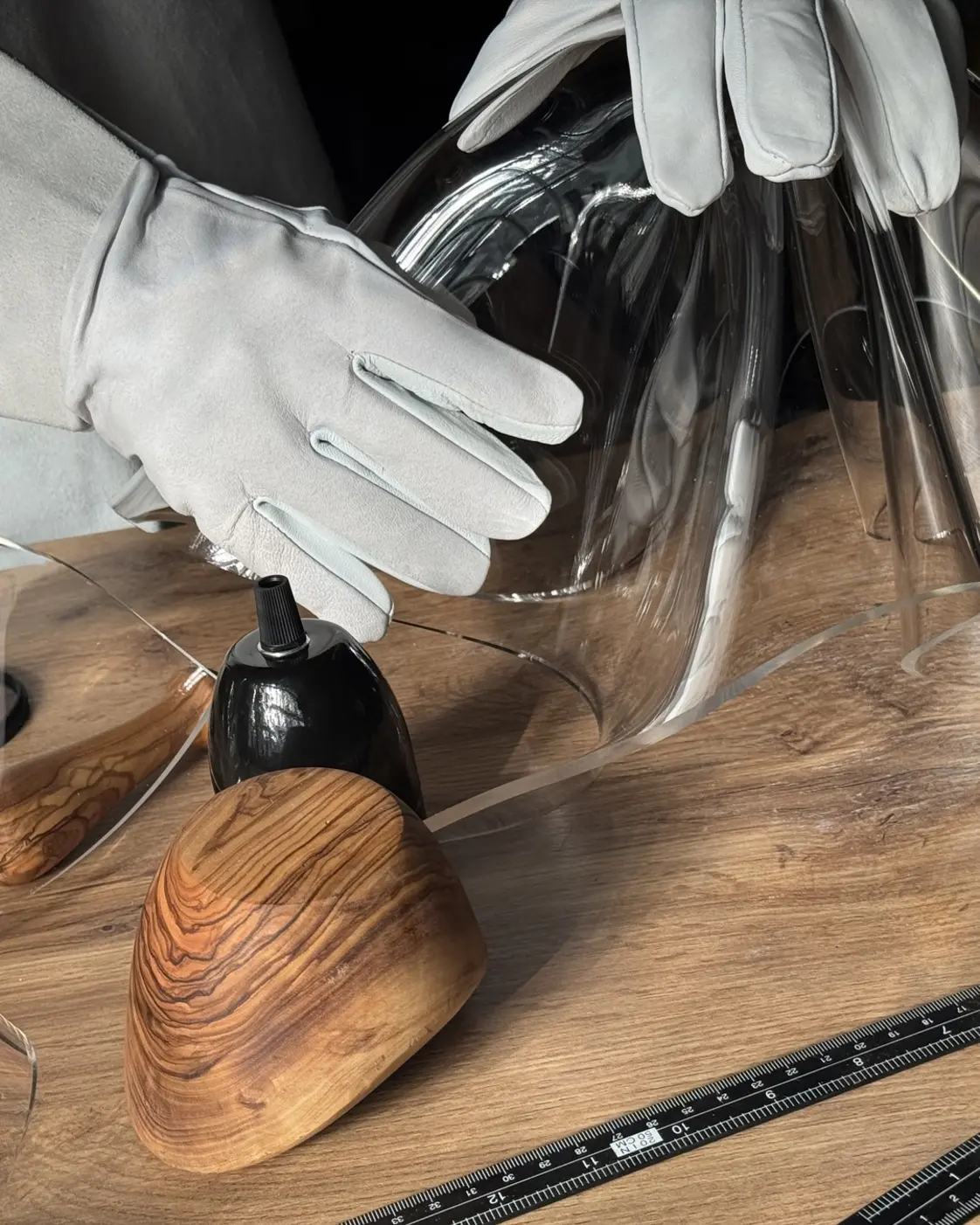
The hardest part of my craft is not what you see in the finished lamp. The hardest part is the moment between the oven and the form: a dozen or so seconds when the sheet of acrylic glass (PMMA) is as soft as heavy fabric, and you can do with it only as much as time allows.
The heated material does not wait. It cools from the edges, stiffens in my hands, and every second of hesitation is recorded in it forever. Before I lift the sheet, I therefore need to hold the entire movement in my mind: how I will place it, where I will let it fall, which fold I will support and which I will leave to gravity. After that, there is only execution. It is a little like a gesture in calligraphy: you may prepare for it for an hour, but you make it only once.
And that is precisely why no two shades come out identical. It is not that I cannot repeat the movement. The material simply responds a little differently each time: the temperature, the thickness of the sheet, the humidity in the air, a fraction of a second of difference. The form is a record of one specific moment, and the next moment produces a different record.
For a long time I wondered whether this was a flaw in the process that I should eliminate. Today I know that it is the substance of the process. Industry can make a thousand identical shades, and rightly so — that is what it is for. A hand can make one. One at a time.
That moment is not in the photographs because it passes too quickly. What remains after it is: two shades from the FLOW series, made by the same hands and differing in a fold.
And you — do you have an object at home that you know has no other exactly like it?
You can read the full text here without an account. The conversation around this topic also continues on LinkedIn.
Join the conversation on LinkedIn →