
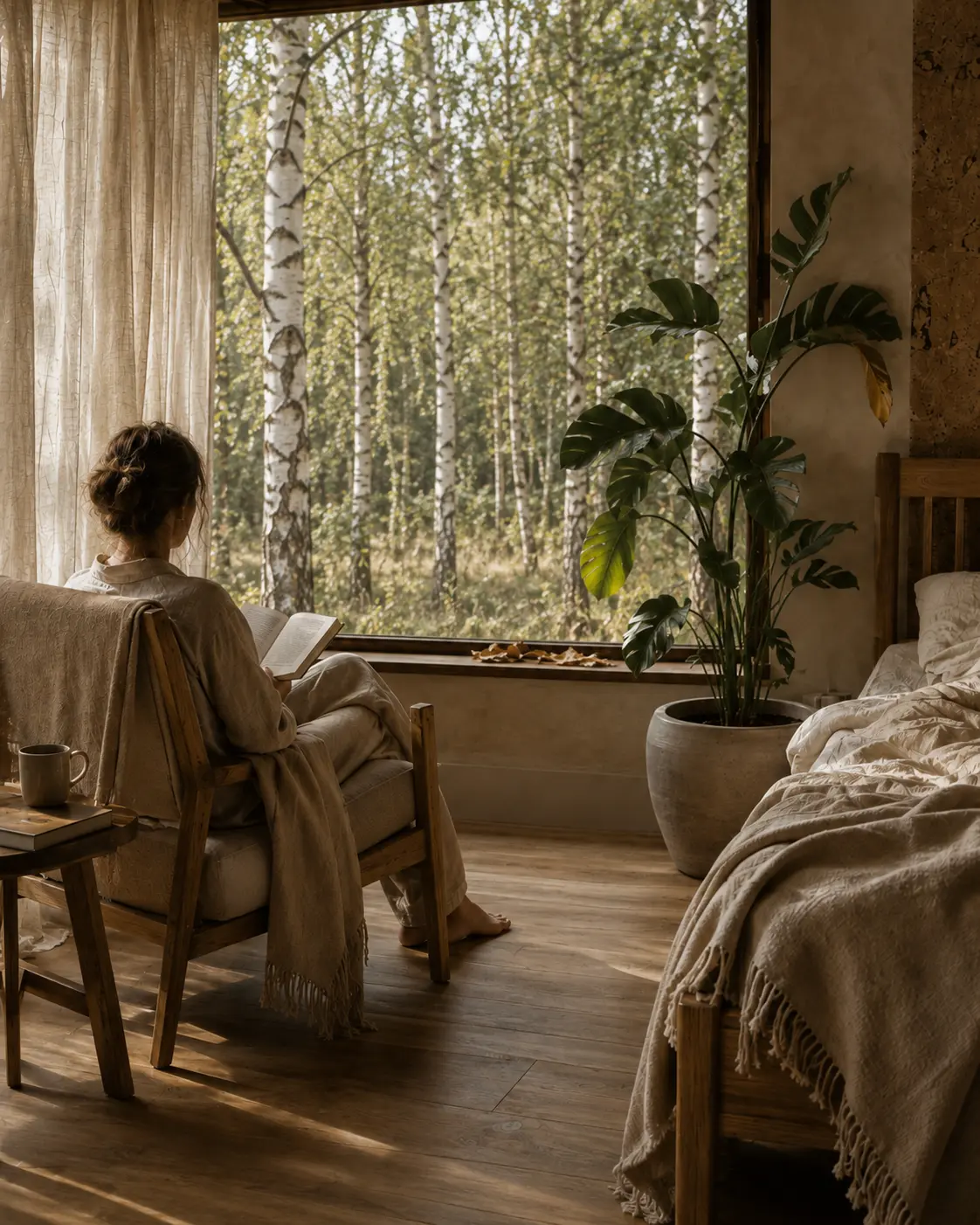
For the end of this series, I saved the finding with which it all began — the oldest, simplest and perhaps the most beautiful in this entire field.
The year is 1984. American researcher Roger Ulrich compares the records of patients who underwent the same operation, in the same hospital, in almost identical rooms. There is one difference: some windows face a brick wall, while others look onto a stand of trees. Patients with the green view spend less time in hospital and receive fewer doses of potent painkillers. The same procedure. The same care. A different view.
The study appeared in Science and, over the next forty years, inspired an entire field of further research. Later studies associated views of nature and contact with greenery with lower stress and the restoration of attention. Biophilic design extends this principle to plants, natural patterns and materials. I prefer to put it more simply: we are animals that moved indoors only very recently. The longing for the outside remains in our bodies.
The good news is that you do not need a forest outside the window to bring this principle into your home. It can be a large plant beside the place where you sit for the longest. Wood whose grain you can see and feel beneath your hand. Wool, stone and linen — materials that were in the world before us. Sometimes it is enough to turn an armchair so that the sky catches the corner of your eye.
This was the seventh and final instalment of the series. I wrote about light, air, noise, temperature, damp, materials and nature — seven things that affect us every day, whether we think about them or not. If one sentence is to remain from the whole series, let it be this: home is not a backdrop. It plays a part.
The series will return in a new form this autumn. In the meantime, I will ask one final question: what have you changed in your own home during these seven weeks? Even one small thing — tell me; I am genuinely curious.
What affects us
Space affects us even when we do not consciously notice it. In this series we look at how light, air, noise, temperature, humidity, materials and contact with nature influence how we feel and function — drawing on research and verified sources.
See all texts in the Journal →