
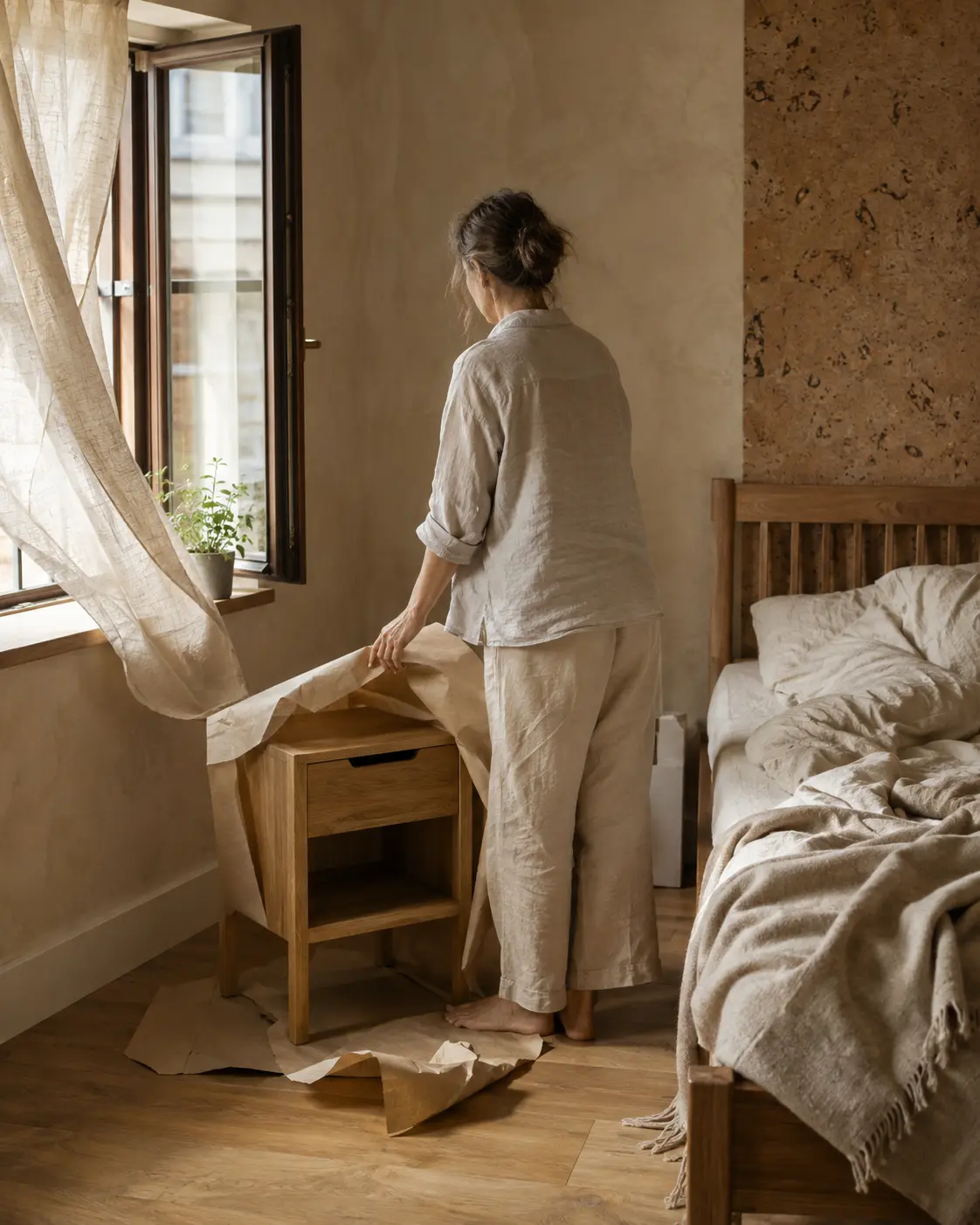
Do you know that smell of new furniture? For years I called it “the smell of newness” — and it sounded like an advantage. Today I know that what “new” smells like is most often volatile organic compounds released from adhesives, finishes and boards. Furniture has an exhaust of its own — and for the first few weeks, sometimes months, it breathes into our room.
I promised this subject — and it closes the thread about air with which this series began.
In the COGfx study, which I mentioned in the episode about air, Harvard researchers examined not only ventilation and carbon dioxide but also the level of volatile organic compounds. Under conditions with lower VOC levels, cognitive test scores were clearly higher. In other words, what our furniture is made of and how our walls are finished helps determine the air — and the air helps determine how we think.
What can we do in practice? Ask for specifics, because the question itself changes the market. With wood-based panels, ask about the formaldehyde emission class — E1 is the minimum, while E05 is clearly better. For finished furniture and interior products, look for labels such as Blue Angel or GREENGUARD Gold; either the seller knows them or does not — and that is information too. If possible, unpack new furniture and let it “breathe” for a few days in a well-ventilated room before placing it in the bedroom. Choose oil-waxed and natural finishes where possible. And remember that solid wood, wool, cork and linen emit incomparably less than board and foam — the old rule applies: “the simpler the composition, the calmer the exhaust”.
Today’s question: do you ever check what the furniture you put in your bedroom is actually made of — the room where you spend one third of your life?
Next Thursday, the finale of the series: why a view of greenery outside the window is not decoration, but one of the best-documented findings in this field.
*Sources: Allen et al., “Associations of Cognitive Function Scores with Carbon Dioxide, Ventilation, and Volatile Organic Compound Exposures in Office Workers”, Environmental Health Perspectives, 2016 (COGfx study, Green and Green+ conditions); Harvard Healthy Buildings Program — “9 Foundations of a Healthy Building”. *Illustration: AI visualisation.
What affects us
Space affects us even when we do not consciously notice it. In this series we look at how light, air, noise, temperature, humidity, materials and contact with nature influence how we feel and function — drawing on research and verified sources.
See all texts in the Journal →