
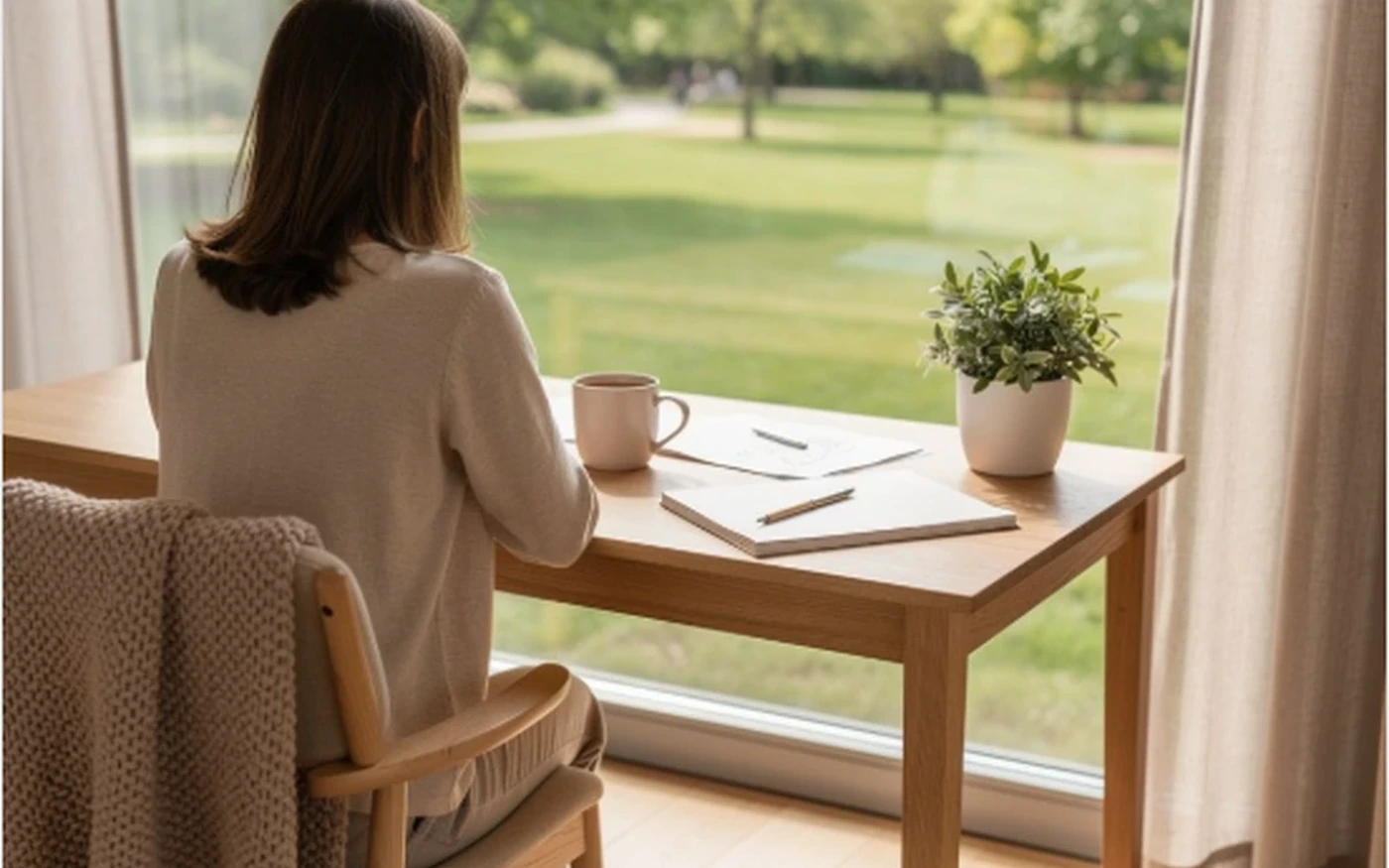
I will begin with a question I often ask: where do you sit for the longest — and what do you see then?
Most often, this is how it happens: we choose a flat by location, furniture from a catalogue, and a place to work… according to where the last free socket happens to be. In the era of hybrid work, we then wonder why days spent working from home tire us more than days in the office.
Science has something important to say here. When the Healthy Buildings team at Harvard University organised decades of research, it placed daylight and the view from a window among the nine foundations of a healthy building — alongside air and water quality. Not as decoration. As a foundation.
Let us experience this together: sit where you spend the most hours and check — how much natural light do you receive between 9 a.m. and 3 p.m.? Are you facing the window or the wall?
And if the answer does not please you? Nothing is lost. Sometimes it is enough to turn the desk around. Great changes often begin with such small turns.
Next Thursday we will examine what the air in a room does to our thinking — and the study that described it.
What affects us
Space affects us even when we do not consciously notice it. In this series we look at how light, air, noise, temperature, humidity, materials and contact with nature influence how we feel and function — drawing on research and verified sources.
See all texts in the Journal →